


I’m writing this as I’m still trying to figure things out.
I’ve been quite skeptical about this whole AI era, particularly in the context of design tools. I mean, the whole prompt-to-app shabang hasn’t made a strong impression on me. But it made it clear—things were about to whirl:

At the same time, which was about a year ago, I was self-debating about this whole topic and started to lay out my thoughts. I haven’t made it through to publish it as a self-contained post, but revisiting it now allows me to see more clearly what was going on in my mind:
It’s clear and inevitable that a shift is coming to design, like in everything else.
For the longest time design has been static.
If you think about it, the way we’ve worked hasn’t changed much from the Photoshop days, which makes sense since the infrastructure hasn’t changed, if not just fixated.
Everything we’ve made in Photoshop to Sketch and Figma has been like this: to get something interactive, you had to build a prototype, or even code to some extent. From the JPEG days of InVision to these days, things haven’t evolved. Dragging points from A to B to create a flow or clicking to create interactions has progressed only to the artboard, not further. Figma utilized a feature called Smart Animate to make things more captivating but the mechanics remain primitive—naming layers appropriately and pointing screens to each other.
The result is a prototyping process that feels oddly heavy and inefficient. It consumes a lot of time, like setting up a development environment. Not only that, it’s basically impossible to maintain a prototype without breaking things while doing so. Every time you make a change in your messy design file, you need to wire the cables all over again. In our modern design days, ironically, this is how prototyping static design feels—like a manual telephone switchboard:


But I wasn’t just ranting:
The low to high wireframe fidelity is also becoming redundant once we achieve a decent result on the first go. Going through iterations could be much, much easier. And all of a sudden design might not be about drawing rectangles and placing text. To orchestrate the new paradigm all you have to do is to type (or talk). Instead of choosing tools and modes and flows, you just… describe what you want.
Then I summarized:
I’m not the AI-tech-optimist type of person, like at all. I also don’t know how AI will help designers.
Things have changed massively over the past year since I wrote the above, but I have much more sense now.
As a designer who likes to build stuff, my main bottleneck was always bringing ideas to life—finding the right developer, or even just a developer, to make my ideas work outside the frame. I tried coding a few years ago (yo Clojure fans), but it didn’t really stick, pretty much like Pavel told me in Niche design (expect the school part):
Back in university, when I first touched code, I could tell I couldn’t stand it. I understand the architecture and basics, and I have huge respect for people in that field, but it’s something I can’t do. It’s just not me.
But recently, something started to shift, and how not with the emergence of Claude Code, which led me to build many things: small products, personal tools, and client projects:
I made an app for my wife and me to track our newborn's daily activities, AKA eat-shit-sleep.
I built a Chrome extension for capturing HTML divs to Are.na channels
Basically, this list I made 3 weeks ago is already outdated
Slowly, then all at once, I’ve found myself doing “building” work instead of just “designing.” My job kind of shifted without me fully realizing it:
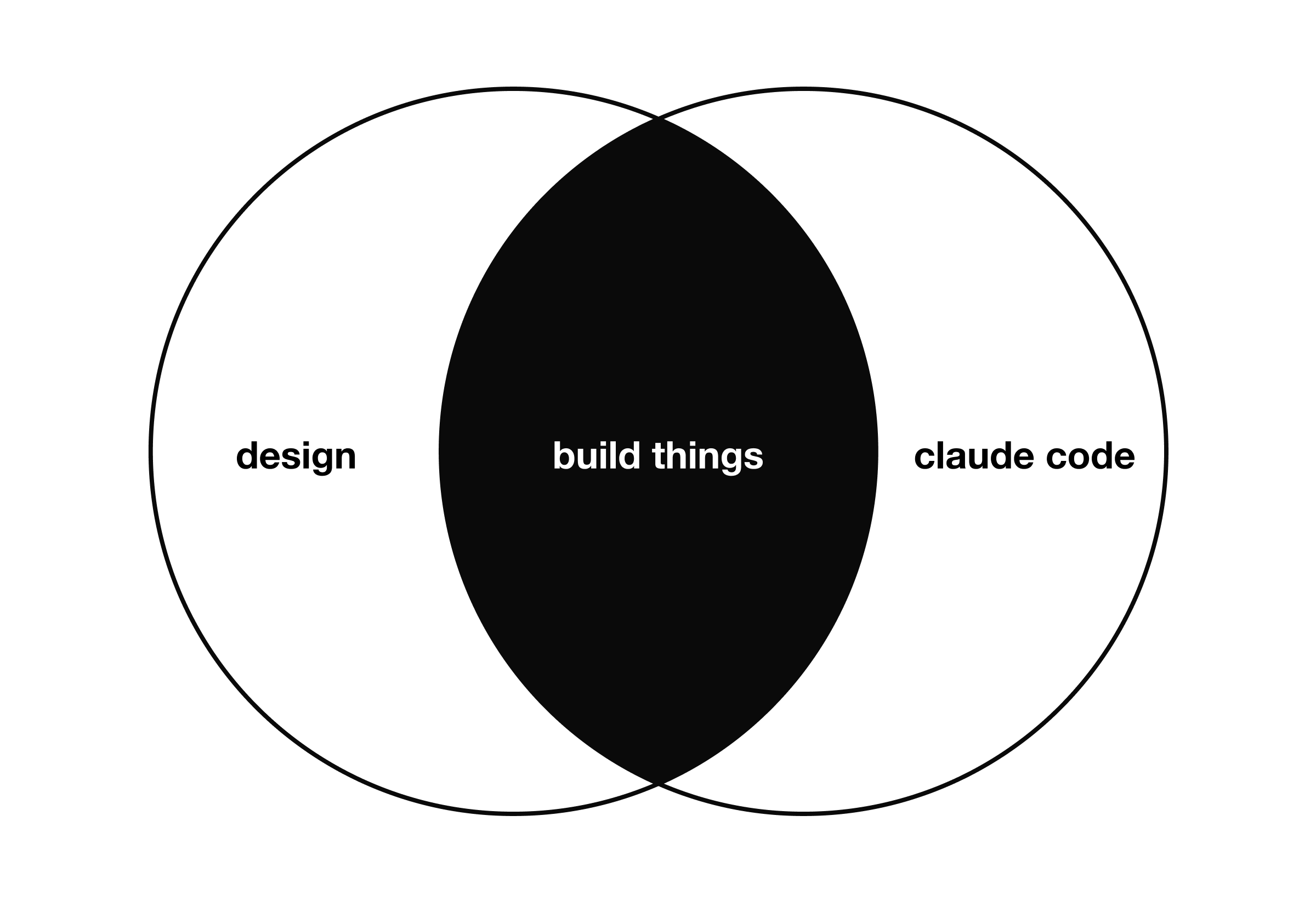
I spend way less time on planning and kind of rush to prototype something into a working state. It makes it easier and faster for clients to grasp, but it also reduces the time I let an idea be baked. I’m not sure yet if that’s entirely good or bad.
I’m not going to delve into the “AI revolution” discourse and its implications for developers or designers, but there’s something in that shift that you and I can’t ignore, to say the least.
Does writing thousands of lines of code equal drawing shapes and typing text blocks on a canvas tool? In any case, I’ve been prompting rather than doing it manually for the past few weeks.
However, unexpectedly and more importantly, it made things fun again. I was frustrated with software and tech culture over the past few years, especially around design, which led me to explore alternative subcultures through Niche design. But these past few months have brought me back that early joy of just building stuff and figuring it out while doing.
In fact, it opened up another path, which is shaping up as a new pedagogy of mine. I’m starting a workshop around it (yet to be formally announced, or maybe I just did?). Either way, it’s something new I’m beginning to explore.
And to give you a glimpse inside it, this Thursday, which is today, or tomorrow for some of you, I’m doing a live session where I’ll take an idea on the spot and build it live with Claude Code. What I want to do is to demonstrate how I think these days and how magnificent it is to go from an idea into something that actually works in a short span of time.
I’ll walk through how I work, not really a clean process—more like a rough idea → some direction → design → build → deploy. It’s going to be in a freeform style, and hopefully, you might pick up a thing or two.
If you’re curious about this way of working, or just want to see how this actually looks in practice, feel free to join. You can also submit an idea beforehand, and it might get built live.