


This is my first essay from a series about the creative process, which will be published in the upcoming Niche design issue.
When my wife and I decided to get married in the spring of 2024, we knew we wouldn’t do it traditionally. Not for religious or spiritual reasons, but more because we didn’t resonate with the concept of the popular modern wedding, which means getting a vanilla venue, inviting hundreds of people we don’t know, and following the rest of the common wedding checklist. We wanted to make it more intimate and authentic to us.
The truth is that our celebration wasn’t so radically different or unheard of. We had a religious ceremony, along with many of the usual wedding elements you’d expect. There were photographers, a catering service, DJ crew, open bar, and even a cyan Beetle converted into a photo booth. A wedding planner was also hired to help us coordinate it all.
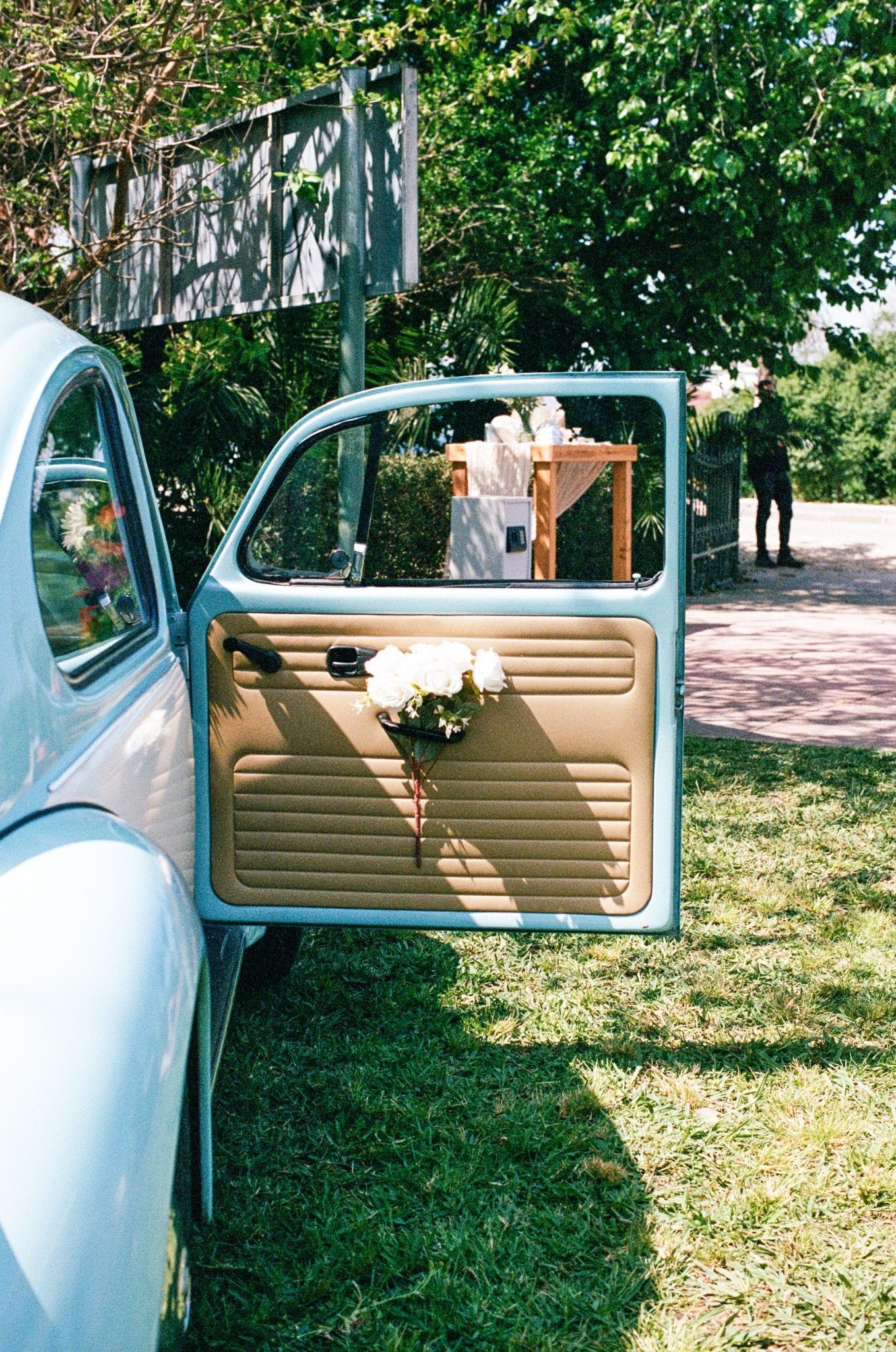
However, there was still something different about it. It was more DIY than a grandiose festival. Rather than renting a venue, it took place in the yard of a family friend who graciously lent it to us for the special day. In this spirit, we did many things by hand: my wife took care of the floral decorations, signage, seating arrangements, and anything else that could be handcrafted. We even supervised the gardener and cleaned the garden ourselves the evening before to make sure everything was ready.
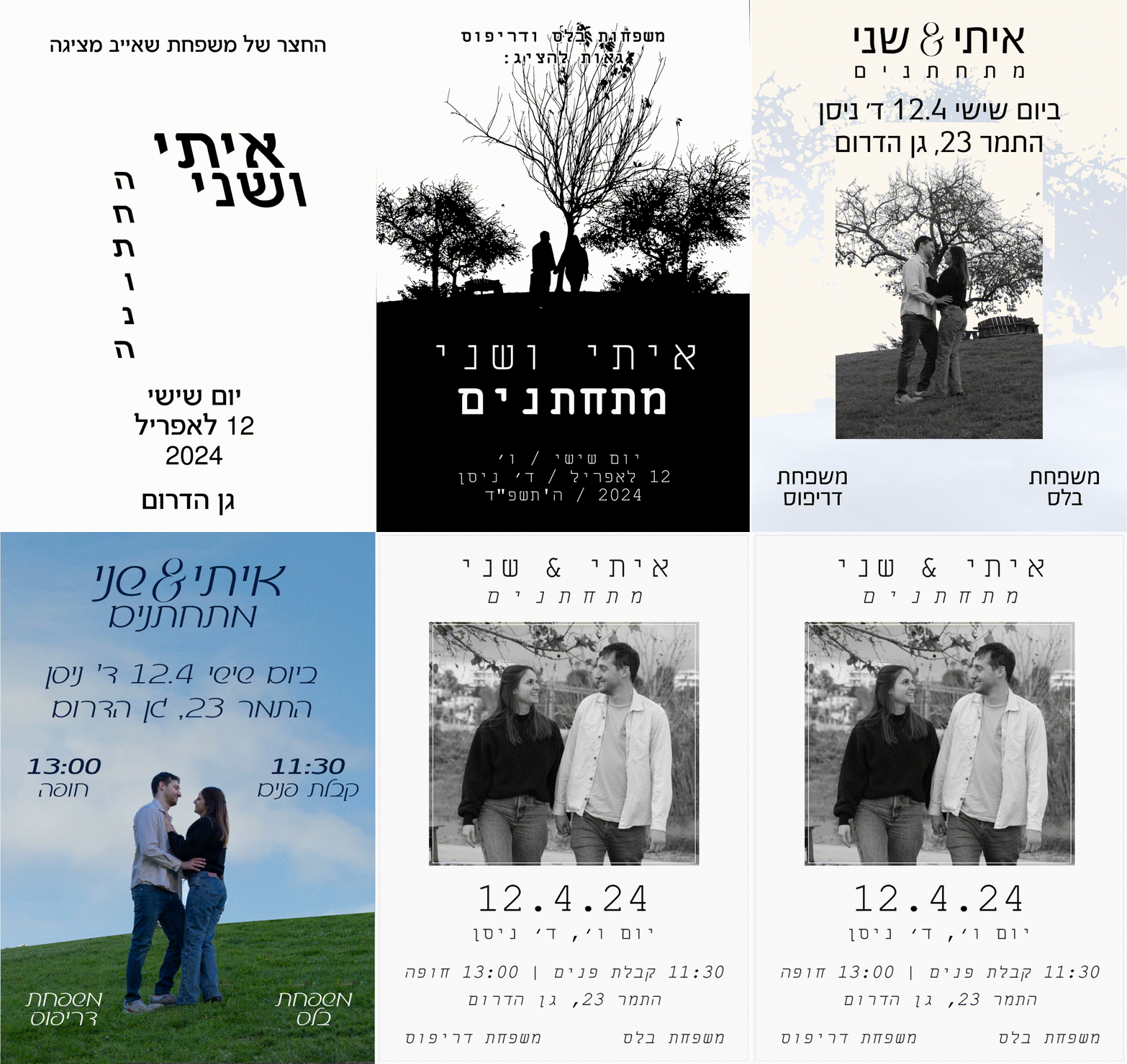
Besides my main task, which was, of course, to show up on time, I was also responsible for the invitation design. As I had expected, making this small artifact turned out to be quite daunting and disproportionate to its physical size. It took me about a month of procrastination, going back and forth, until I finally settled on something, while making a few compromises. It also took my wife-to-be to get me into the mood and force me to finish it, so we could send it to our guests before the wedding was actually held.
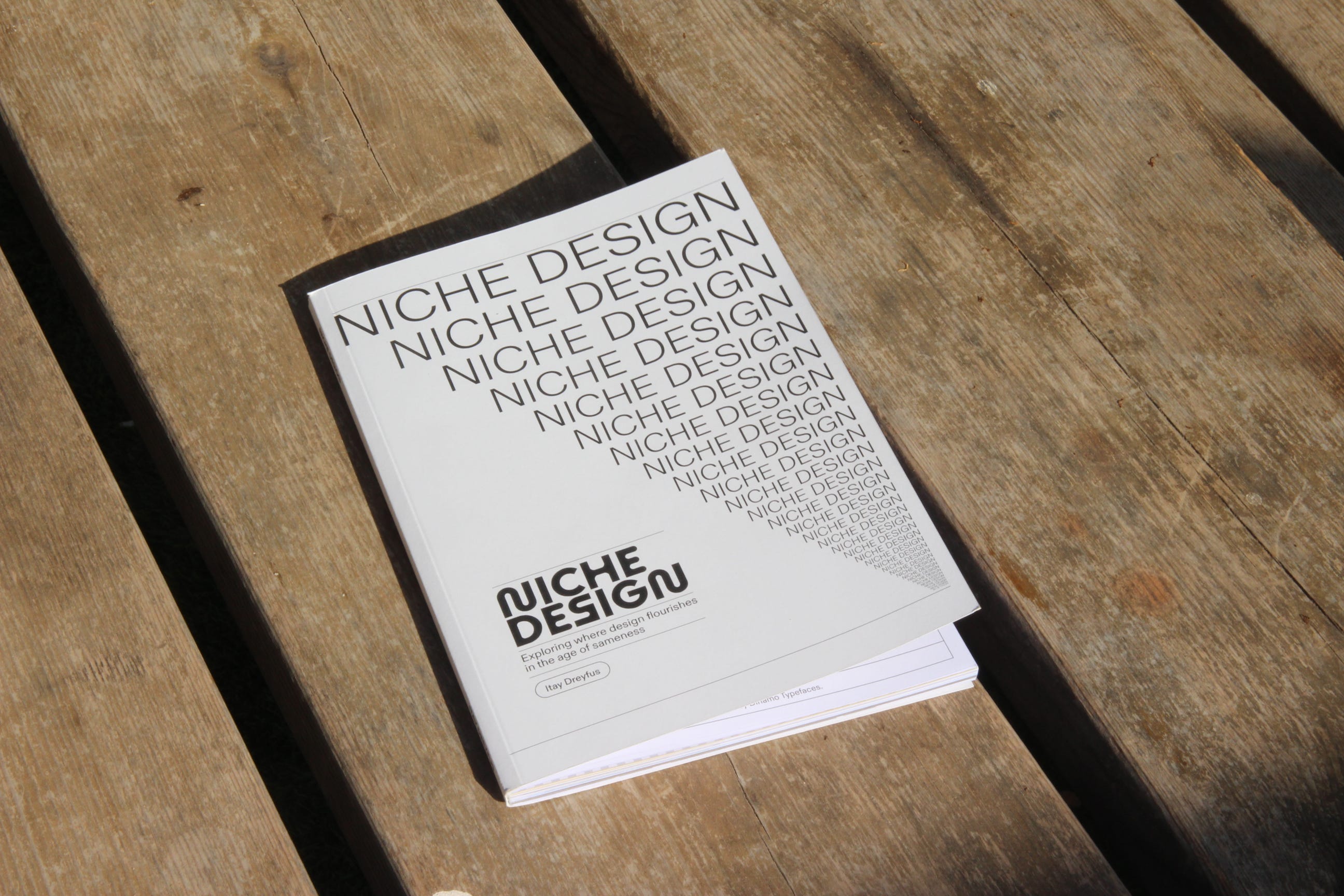
In the following year, I was mainly focused on making the first Niche design issue, juggling an enormous list of to-dos: researching, writing, editing, curating, coordinating, testing, printing, and so on. I was also working wherever I could: at airport gates, on planes, in cafés, on my phone…
It required a ton of mental resilience to bring it to completion.
However, when I reached a point where like 90% of the project was completed, I got painfully slower. I was running out of steam—my ideas were drying up, and decisions were harder to make. Every week I was telling myself that next week is next week. But with each passing week, I became more and more delusional about how far I still was from the finish line.
Nevertheless, I kept reflecting on that particular experience as some kind of a post-mortem, but nothing could really crystallize in my head. Only when I started to prepare for this year’s issue did I realize there was a very personal sentiment that made it so difficult to work on. I had become deeply attached to the work—exactly like the wedding invitation.
Progress
“Reznor and Ross observe the same hours, Monday through Friday, 11 a.m. to 7 p.m. “We show up,” Reznor told me. “Were not late. Were not coming in to start to fuck around.”
Trent Reznor and Atticus Ross Have a Plan to Soundtrack Everything
Zach Baron
When I interviewed Pavel Kedzich for the first issue, he said something that immediately struck a chord: “Design isn’t about impact. It’s about finishing the work”. The context of our conversation was questioning the purpose of the designer role in our lives, but I find it applicable in broader contexts.
What’s the purpose of design, or any other practice? If we don’t finish and release the work to the outer world, outside of our head, screen, or notebook, then what does it matter at all? Is there anything, novel as it may be, that’s more important than making it a fact?
There have been a lot of misconceptions about the outcomes of work, which I’ve admittedly long held and wanted to believe in. Achievements like changing the world or making it a better place are quite popular in pop-design culture, and have romanticized creative work throughout the post-millennium startup era. However, after being immersed in this scene for quite some time, I’ve come to realize that these are only narcissistic aspirations, which don’t really hold in the business of money-making. These seemingly noble ambitions mostly exist in job postings and pitch-deck fairytales.
Therefore, “get the job done” seems to be the first and foremost important thing.
Then there’s this idea of making our work easier. Automation is now king amid the evolving AI revolution, but long before that, the internet was already full of people advocating for systems and frameworks with the premise of getting more done.
But the way I see it, meaningful work was never meant to be easy. Instead, I like to think of it as something that’s supposed to be progressable.
What we call the creative process is inherently complex, both cognitively and emotionally. It’s a continuous activity that drains every bit of our energy. It consumes so much from us and somehow drags on for weeks, months, or years.


In a way, making progress is the purpose of it all: being able to move forward, slightly, each day, to get something done. I doubt if we ever make an impact as designers, and honestly I don’t think that’s even the point. The outcome of our work is in itself. It comes when we first finish what we start. The rest might follow suit, or not.
Like Sasha Chapin encourages to “Just hit the fucking keyboard” in writing, when I just work, without goals or metrics in mind, I'm out of self-analysis and outcome prediction. I’m set free to just do my thing. I focus on just making progress and on what needs to be done. And yet, I feel a little embarrassed by writing that, because most of the time, it’s exactly what I don’t do. But when I do—I just work. The flow then naturally comes: I hit my keyboard, moving rectangles, typing words, or prompting Claude to code. I don’t think about my impact, or whether my work would receive any attention.
Whether I’m learning a new skill, building something new, or writing an essay, the goal stays the same: to keep making progress.
Attachment
Frequently people don’t realise what makes them interesting because they’re so close to it.
In all of my years in design, I strived for excellence, but in reality I’m not sure how much of it I actually achieved. For a long time, I thought I was examining the world through an extremely designer-judgy eye, as part of my perfectionism. But as you’re about to read, I’ve come to understand that my obsession has been rooted in something else.
In this journey we call a career, I’ve learned that our attachment level gets stupidly high when we work on the things we care about the most. In the first issue, Charles Broskoski, one of Are.na co-founders, described his own tension by being both the founder and audience of his own company:
There’s a double-edged sword to being deeply enmeshed in the community that you’re serving; the good side is that you can be deeply empathetic to your customers, but the bad side is that you might feel your identity gets a little bit more intertwined with the thing itself.
That was said in a different context, but I think it captures the feeling of my attachment quite well.
Take the portfolio task, for example. The median designer would greatly suffer and procrastinate only by the passing thought of making one—including myself. Naturally, we’re so attached to it. In fact, it’s very much about our identity—what reflects the most “me” thing? How might I brand myself? How do I want people to perceive me?
I probably have hundreds of portfolio revisions buried in my drafts. Every time I sit down to design a new one, I feel this deep desire to crack it. There’s a struggle to get out of my head, so I can “solve” the problem and find the best possible solution. But in reality, every decision invites another revision, and every revision another doubt, until finishing begins to feel impossible.
In many ways, my attachment is both what drives me and what holds me back.
For the longest time, I was stuck in this mindset. I thought being attached so much was a virtue. A seemingly proof of commitment, loyalty, and professionalism. But only recently have I realized I had turned it into a hurdle of my own making. I crossed the same line over and over again, and each time my frustration only grew. I had become so emotionally attached to the work that I became paralyzed.
Have I mentioned designing my own wedding invitation already?
Client vs. personal work
It’s been a few years since I quit my last full-time position and went indie officially for the second time. A common pattern I noticed while working with clients wasn’t new to me. I used to care a lot about the work itself. I felt like I needed to think hard about everything I do and try to reinvent constantly. I wanted everything I do to be at the highest level. I wanted people to pick my ideas, and to make them say “I’m right”. Whenever a decision wasn’t made in my favor, I felt my ego bruised.
But over time, and as I started freelancing more and more for myself, I began to feel the cost of that attachment. I found myself getting into debates and spending far more time than I should have trying to push the work a little further. Eventually, I realized how much anxiety it was causing me. It became clear that I needed to save my battles for my own projects.
As I was trying to figure this out and make my day-to-day more bearable, I found a little trick, which I probably should have done long ago. Some would argue obvious or perhaps a sin, but the truth is that I just started to “care less”.
I don’t want to diminish client work1, but the simple truth is that by default, I have more distance from it. No matter what I do, I’m not the decision maker. I’m not the founder. I’m the audience, and that’s liberating, as I find it much easier to detach and go with the flow.
However, when it comes to my personal projects, I find it much harder. Each time, I go through a meticulous and tiring self-introspection in the process: I’m going down too many directions instead of putting constraints early. At times, it gets me to a point where things become disorienting. I can feel highly rewarded, but simultaneously, I can feel the pain. I feel like every pixel, word, or color choice might be crucial—small decisions that seemingly would reflect my entire practice, or even my existence. Thus, even making a tiny “mistake” causes me great suffering.
I knew this wasn’t a healthy practice. I couldn’t release the first Niche design issue without changing my approach, or else I would still be working on it to this day. So, as an experiment, I started to implement this new “client approach” on my own projects. And when I made that switch, things started to shift.
When I put some distance between me and my work, then ideas, or at least the ability to play with them, become feasible. The more I’m loose, the more I’m able to go wild. I can diverge and converge, and then again, again, and again. I let myself get into more productive creative cycles.
In contrast, when I put too much focus and care, I start to lose momentum. I burden myself with too many options, and too many decisions, with too few constraints to make progress. I hold myself back from pursuing seemingly silly ideas, which prevents me from experimenting—and from discovering where those ideas might have led.
That’s why I find it helpful to step away from what I do when the work gets too much in my way. Like pretending that it’s someone else’s thing. To get in the mindset that I’m just here to finish the work. To help someone else figure things out. To be in the guiding position. Because in most situations it’s only me inside my head. It’s me fighting with myself.
Once I change the lens through which I see the work, I begin to live with it more peacefully. My perspective shifts. I’m starting to see my work differently, and there’s more comfort with its outcome. I’m gradually moving from this “not good enough” thinking and focus on the things that matter, without getting lost in endless spirals.
Patience
“The best thing is just take the pressure off, follow my curiosity, let it accumulate, and trust the process that it’s going to arise, something that just wants to be born through me.”
Henrik Karlsson on David Perell’s How I Write podcast
Trusting the process is underrated.
The journey of making something worth sharing with the world is long and exhausting. And if there’s one thing I’d preach for, it’s that nothing can be forced. It takes time for things to mature. The problem is that it’s a slow process, and you can’t see it unfold. Most days don’t feel meaningful at all. They consist of mundane routines with repetitive tasks, and tiny decisions that seem to lead nowhere. The reward rarely comes immediately—it arrives weeks, months, or sometimes years later, when all those invisible steps have quietly accumulated into something real. Only in retrospect does it all become visible.
When writing an essay.
When designing a website.
When programming software.
When composing music.
It’s all the same.
The work reveals itself.
Trust it.
Product Identity is completely free. If you wish to support my work, purchasing a copy of Niche design, either in print or digitally, is the best way to do so.
I absolutely don't mean to suggest that I disrespect the work that provides for me and my family. My intention is simply to surface an intrinsic experience that I've been trying to make sense of.